Prompt Monkey
When AI Creates the Illusion of Technical Skill
Prompt Monkey: When AI creates the Illusion of Technical Skill
The other day, I was talking to someone who had apparently won a competitive CTF tournament at my college. With the arrival of AI in such tournaments, I asked him what he thought about its use in these environments, since CTFs had started to become less about putting technical knowledge to the test and more about AI vs. AI.
In his view, AI was merely a tool, not an agent capable of analysing context and reaching rational conclusions. That was where I disagreed. Comparing an artificial intelligence with trillions of parameters to a screwdriver made no sense to me.
At one point, I compared using AI to following write-ups:
“If the thought process behind the result isn’t yours, but entirely Claude Code’s, there’s no real difference between that and using a public write-up made by someone who has already solved the machine. In your opinion, are a person who uses write-ups and another who doesn’t at the same technical level?”
He hesitated for a moment and said:
“Haa… Yes, because they got the same result…”
I was astonished.
“So, for you, Capture the Flag was never about testing your own technical knowledge. It was just about getting a string from a virtual machine, receiving a message saying, ‘Congratulations, you did it,’ and feeling smart because of it?”
He realised that his view was kind of messed up and admitted:
“You’re right, they’re not at the same technical level. But for me, AI is still just a tool, and we will not agree on this point. Goodbye.”
Then he left.
The conversation made me think about how many people in this field confuse real technical knowledge with merely following AI-generated instructions. That is the topic of this article.
1988 — Script Kiddies: The Most Famous Wannabe Hackers
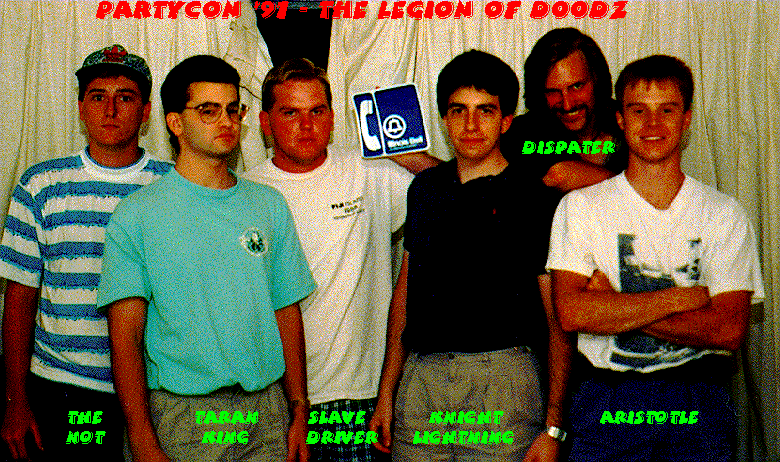
The term “script kiddie” was first used in 1988 in the master’s thesis Information Security, Privacy, Issues and an Application, by Saliha Figen. [2]
Some years later, Phrack, a group composed mainly of teenagers who wrote articles about operating systems and other technologies, used the term in articles 9 and 11 from 1998: [3][4]
“[…] when someone posts (say) a root hole in Sun’s comsat daemon, our little cracker could grep his list for ‘UDP/512’ and ‘Solaris 2.6’ and he immediately has pages and pages of rootable boxes. It should be noted that this is SCRIPT KIDDIE behavior.” [3]
But what is a script kiddie?
A script kiddie is a derogatory term used mainly in cybersecurity to describe someone with little technical knowledge who relies on tools made by others.
These people became increasingly visible with the rise of 2000s YouTube tutorials such as “How to Deface a Website,” often recorded by people typing commands into Notepad.
Even without much technical knowledge, script kiddies can still be dangerous. Because they do not fully understand what they are doing, they are more likely to cause harm or produce unpredictable results.
However, almost everyone interested in cybersecurity starts, to some extent, as a script kiddie. They like the idea of getting into systems but do not yet have enough knowledge to do it by themselves.
That is not necessarily a problem. I started as a script kiddie myself and began studying seriously when I realised how little I knew.
But what happens when script kiddies never face that reality?
Today’s technology can give them a false impression of progress and competence. Instead of evolving beyond the script kiddie stage, they become something else.
Something I baptized a “Prompt Monkey.”
Why AI Creates a False Sense of Competence
A Large Language Model does not think in the same way a human does. At its core, it receives text, breaks it into smaller units called tokens and predicts which token is most likely to come next.
This may sound to some like a random word generator, but this description is incomplete. The model doesn’t select words randomly from a dictionary. It analyzes the context of the conversation and uses patterns learned from an enormous amount of text to calculate the most probable continuation.
For example, if someone gives it the output of a network scan, it may recognise patterns involving open ports, services and known vulnerabilities. It can suggest what to investigate next, generate the next commands using information that is available online and interpret results.
This does not necessarily mean that the model understands the situation as a human expert would. It’s important to clarify that it still has no personal experience, intentions or awareness of whether its answer is true. It can produce a convincing explanation simply because that explanation matches patterns found during training.
However, even if an LLM is not able to understand a situation as a human would, that doesn’t make it irrelevant to the discussion about technical competence. A system does not need consciousness to perform part of a cognitive task.
If the AI identifies the vulnerability, chooses the tools, generates the commands, interprets the errors and decides the next step, then most of the problem-solving process came from the AI, not from the user.
Therefore, the important question is not whether the AI is truly thinking.
The important question is:
How much thinking is still done by the person using it?
The Origin of The Term: “Prompt Monkey”
There is an engineering niche based on structuring natural human language to make generative artificial intelligence produce more accurate, relevant, or useful outputs for the user. It is known as prompt engineering. [5]
During the AI boom of the 2020s, employees with the title of prompt engineer were hired to create prompts that would increase business productivity. A branch of ethical hacking was also developed around the idea of bypassing AI security guidelines to make AI systems do things they were not supposed to do, which became known as prompt injection. [5]
Based on the fact that AI can reduce a great part of analytical thinking because of its pattern-recognition capabilities, when an individual starts delegating the great majority of their critical thinking to AI, copying and pasting results instead of thinking about them and reaching their own conclusions, that person is, by definition, a Prompt Monkey.
This does not apply only to the ethical hacking world; it applies to any other field, even outside technology, where people stop trying to find solutions by themselves and start generating everything with ChatGPT.
A Human Resources manager who delegates an important business email entirely to AI is a Prompt Monkey. A teacher who creates all their tests with AI, without doing any previous research on existing questions about the topic, is a Prompt Monkey. Above all, a person participating in a Capture the Flag tournament who sends tool outputs to Claude Code every few seconds, without deeply thinking about the problem, is a Prompt Monkey.
Spending Most Their Lives Living in The Dumbass Paradise…
The main problem with excessive AI use is not merely psychological, nor is it just a case of the older generation abhorring the new one. It is factual, and it has been repeatedly confirmed by several news reports and studies.
According to a recent MIT Media Lab study, “excessive reliance on AI-driven solutions” may contribute to “cognitive atrophy” and the shrinking of critical-thinking abilities. Senior Research Fellow Christopher Dede added: [6][7]
“If AI is doing your thinking for you, whether it’s through auto-complete or whether it’s in some more sophisticated ways […] that is undercutting your critical thinking and your creativity.” [6]
Another researcher, Fawwaz Habbal, Senior Lecturer in Applied Physics, stated:
“I worry about students relying too much on AI. We have to remind students that we’re trying to help them become the future leaders of society, and part of developing leadership is to add new value to society; and that is a human enterprise […] Only humans can solve human problems.” [6]
So, if excessive AI use is so harmful to human cognitive abilities, why is this way of using AI still the most popular? Because it is easier and quicker to send a prompt to an LLM than to reach a conclusion yourself.
In today’s world, where the average human attention span is eight seconds, doing things more quickly and easily has stopped being something associated only with lazy people and has become the norm.
MIT research scientist Nataliya Kosmyna, who studies the interaction between humans and machines, concluded that what she calls “cognitive offloading” to AI can have a corrosive effect on our mental abilities. The consequences could be alarming and may even contribute to cognitive decline: [7][8]
“The ChatGPT group showed notably less brain activity — it was reduced by up to 55%.” [7][8]
When Human Stupidity and Corporate Greed Collide…
According to the study Beyond Automation: Understanding Unemployment in the AI Epoch from a Global Viewpoint, rapid and unprepared AI integrations tend to amplify the negative effects of unemployment on subjective well-being and exacerbate inequalities, particularly among the most vulnerable populations. [9]
Some researchers believe that AI and automation could eventually replace a large number of human jobs. One widely cited estimate suggests that around 47% of jobs could be automated (Frey & Osborne, 2017). [10]
In terms of impact magnitude, Acemoglu and Restrepo (2020) confirm that each additional robot per thousand workers reduces the employment-to-population ratio by 0.2 percentage points and wages by 0.42%. [11]
And that number may continue to grow as computers become faster and AI systems become better at tasks that once required human reasoning. But the problem is not simply that technology is becoming more capable. The problem is that companies have a financial incentive to replace workers whenever doing so is cheaper, faster and more profitable.
While AI is sold to enterprises as a solution that will help workers, in reality, many companies are also looking at it as a way to reduce salaries, remove positions and increase productivity without sharing the benefits with the people whose jobs are being transformed or eliminated.
When people blindly accept every new technology as progress and companies see human workers only as expenses, human stupidity and corporate greed collide. [12]
Why After All, AI is Still Not a Villain…
The final point is that AI is not a bad thing; it is the way AI is used that can be harmful. Any tool, when used inappropriately, can hurt its owner. The fact is that there is a clear difference between learning from AI and making it do all the work for you.
It only becomes degrading when AI becomes the decision-maker and you become the tool that executes and presents its conclusions. Saying that AI is bad in itself is like saying that credit cards are inherently bad. A credit card will not stab you in the neck, but the way you use one may become a problem.
Even at the corporate level, when companies start replacing a large number of human jobs with AI without proper planning, they suffer the consequences. This is supported by a study conducted by CloudBees, in which more than 200 technology executives were surveyed about the use of AI in their companies. Eighty-one percent reported problems related to AI-generated code after deployment, including functional errors, security vulnerabilities and performance issues. Additionally, 63 percent reported compliance violations caused by AI. [13]
Therefore, even companies that employ white-collar workers are learning the hard way that massive replacement by AI is not the answer to increasing profits. Making a product is different from making a good one.
Conclusion: The Result Is Not the Skill
The conversation that started this article showed me how easily people confuse reaching a result with possessing the knowledge required to produce it. Getting the flag, generating the code or solving the problem doesn’t necessarily mean that the technical process was yours.
AI still can be an excellent teacher, assistant and research tool. However, when it performs the analysis, chooses the strategy, generates the command and corrects every mistake, the user is no longer demonstrating their own competence. They are only presenting the result of someone or something.
A Prompt Monkey is not simply someone who uses AI. It is someone who consistently avoids thinking, delegates the entire intellectual process and then treats the final output as proof of personal ability.
The real test begins when the AI is removed.
References
[1] Erik. “Hackerpix.” Image source. http://www.erik.co.uk/hackerpix/
[2] S. F. Arifgoğlu. Information Security, Privacy Issues and an Application. Master’s thesis, Middle East Technical University, 1988. https://open.metu.edu.tr/handle/11511/7977
[3] rain.forest.puppy (rfp). “NT Web Technology Vulnerabilities.” Phrack Magazine, vol. 8, issue 54, article 8, 25 December 1998. https://phrack.org/issues/54/8
[4] LiveOverflow. “The Origin of Script Kiddie — Hacker Etymology.” 12 May 2019. https://liveoverflow.com/the-origin-of-script-kiddie-hacker-etymology/
[5] Wikipedia contributors. “Prompt engineering.” Wikipedia. https://en.wikipedia.org/wiki/Prompt_engineering
[6] L. Mineo. “Is AI Dulling Our Minds?” The Harvard Gazette, 13 November 2025. https://news.harvard.edu/gazette/story/2025/11/is-ai-dulling-our-minds/
[7] N. Kosmyna et al. “Your Brain on ChatGPT: Accumulation of Cognitive Debt when Using an AI Assistant for Essay Writing Task.” arXiv:2506.08872, 2025. https://arxiv.org/abs/2506.08872
[8] BBC Future. “AI Chatbots Could Be Making You Stupider.” 17 April 2026. https://www.bbc.co.uk/future/article/20260417-ai-chatbots-could-be-making-you-stupider
[9] D. V. Le, T. Bui, and T. L. Yap. “Beyond Automation: Understanding Unemployment in the AI Epoch from a Global Viewpoint.” Computers in Human Behavior Reports, vol. 20, 2025, article 100864. https://www.sciencedirect.com/science/article/pii/S2451958825002799
[10] C. B. Frey and M. A. Osborne. “The Future of Employment: How Susceptible Are Jobs to Computerisation?” Technological Forecasting and Social Change, vol. 114, 2017, pp. 254–280. https://doi.org/10.1016/j.techfore.2016.08.019
[11] D. Acemoglu and P. Restrepo. “Robots and Jobs: Evidence from US Labor Markets.” Journal of Political Economy, vol. 128, no. 6, 2020, pp. 2188–2244. https://econpapers.repec.org/article/ucpjpolec/doi_3a10.1086_2f705716.htm
[12] N. H. Ahmad, L. Stigholt, L. Duboc, and B. Penzenstadler. “AI Systems’ Negative Social Impact and Factors.” Information and Software Technology, vol. 192, 2026, article 108038. https://www.sciencedirect.com/science/article/pii/S0950584926000273
[13] CloudBees. “81% of Enterprise Technology Leaders Report Production Failures from AI-Generated Code, New Research Shows.” 19 May 2026. https://www.cloudbees.com/newsroom/enterprise-technology-leaders-report-production-failures-from-ai-generated-code